
July - december 2025 (PART-2)
Cover Page July-December 2025
Impact Factor - 3.50 ( IIFS)

Impact Factor - 3.786 ( SJIF )
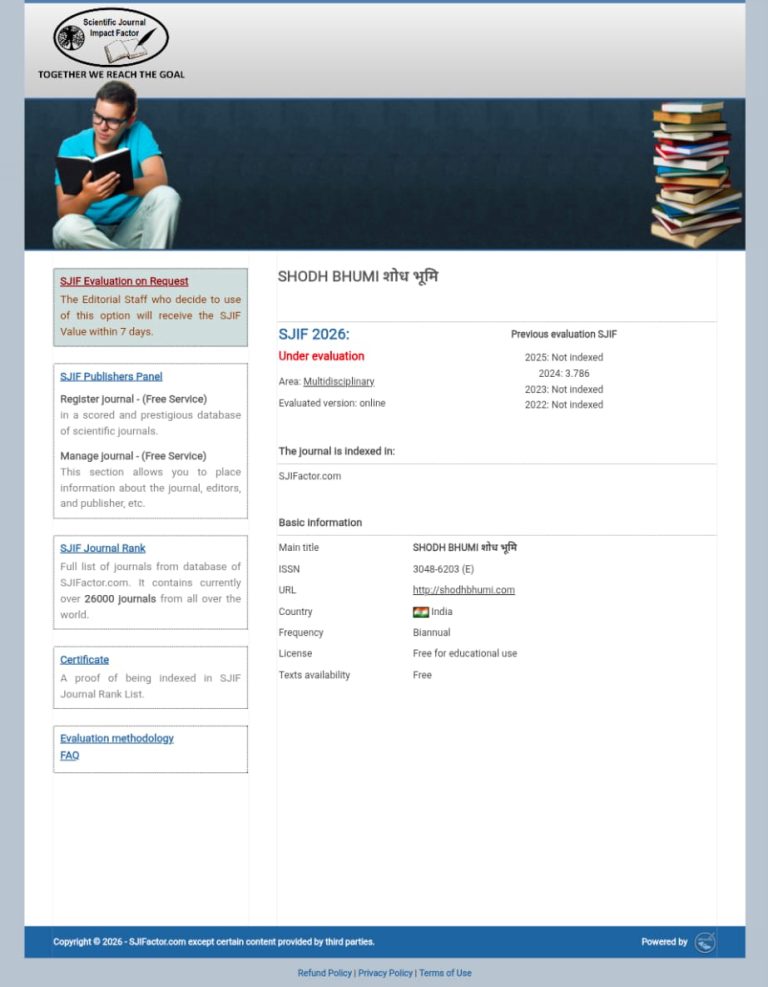
The journal is currently indexed in ROAD (Directory of Open Access Scholarly Research) and Google Scholar.



SHODH BHUMI
[A Peer-reviewed, Refereed, Bi-Annual, Multidisciplinary & Multilingual Research Journal of Education & Pedagogy]
वर्ष -2 | अंक 2 | जुलाई-दिसंबर, 2025
Contents/ विषय सूची
26 . हरियाणवी लोक संस्कृति की प्रदर्शन कलाओं में महिलाओं की भागीदारी का सामाजिक, सांस्कृतिक और लैंगिक परिप्रेक्ष्य में विश्लेषणात्मक अध्ययन
प्रो. ( डॉ.) वन्दना पूनिया
हरियाणवी समाज में महिलाओं की भूमिका केवल सांस्कृतिक प्रस्तुति तक सीमित नहीं है। वे लोक परंपराओं की संवाहक और सामाजिक परिवर्तन की वाहक भी रही हैं। हरियाणवी लोक प्रदर्शन कलाएँ स्त्रियों के सामाजिक-सांस्कृतिक जीवन का आईना हैं, जहाँ पारंपरिक सीमाओं के भीतर रहकर भी वे प्रतिरोध, एकजुटता और सांस्कृतिक आत्म-अभिव्यक्ति का सशक्त रूप प्रस्तुत करती हैं। इस शोध का मुख्य उद्देश्य हरियाणवी लोक संस्कृति की विविध प्रदर्शन कलाओं में नारी की भूमिका, उसकी अभिव्यक्ति, सीमाएँ और सशक्तिकरण के पहलुओं का अध्ययन करना है। गुणात्मक पद्धति के तहत, रोहतक, गुरुग्राम, पानीपत और भिवानी के प्रमुख लोक सांस्कृतिक केंद्रों में चयनित प्रस्तुतियों का विश्लेषण किया गया। परिणाम दर्शाते हैं कि लोक प्रदर्शन कलाएँ स्त्रियों के अस्तित्व को सामाजिक पुनरुत्पादन और सीमाओं के साथ-साथ प्रतिरोध और सशक्तिकरण के द्वैतात्मक रूप में प्रदर्शित करती हैं। संवाद, प्रतीक और प्रस्तुति शैली लिंग आधारित असमानताओं को उजागर करती हैं, जबकि आधुनिक प्रस्तुतियाँ स्त्रियों की भूमिका को पुनर्परिभाषित और पारंपरिक सीमाओं से ऊपर उठने का अवसर देती हैं।
मुख्य शब्दः हरियाणवी लोक संस्कृति, प्रदर्शन कलाएँ, नारी सहभागिता, सामाजिक-सांस्कृतिक परिप्रेक्ष्य, लिंग आधारित विश्लेषण।
References:
Bloomfield, L. (1978). Language and cultural expression. New York, NY: Holt, Rinehart & Winston.
Butler, J. (1990). Gender trouble: Feminism and the subversion of identity. New York, NY: Routledge.
Chopra, R. (2018). Women in folk arts: Social empowerment in rural India. Cultural Studies Press.
Dahiya, B. K. (2020). Haryanvi Saang me Stree Patra aur SanskritikPratibimb, Bal Kishan Dahiya, Folklore Research Journal, 2020.
Gaur, V. (2018). Conditioning of Subaltern: Gender in Haryanvi Folktales. Journal of Emerging Technologies and Innovative Research (JETIR), 5(3), 11-23.
Gupta, R. (2016). Women’s Participation in Folk arts and Festivals: A Sociocultural Sudy. Indian Journal of Cultural Heritage, 5(2), 33-41.
Horton, P. B., & Hunt, C. L. (1982). Sociology (9th ed.). New York, NY: McGraw-Hill.
Kaur, P., & Sinha, A. (Eds.). (2019). Women in Indian performance traditions. Sage Publications.
Khandelwal, S. (2018). Gender roles in Indian Folk Performing Arts. Indian Journal of Cultural Studies, 12(3), 45-60.
Kumar, D. (2017). A Peasant woman’s ballad from Haryana in North India. Asian Folklore Studies, 76(1), 1–21.
Kumar, D. (2023). Representation of Females and Culture in the Haryanvi Ragnis. International Journal of Multidisciplinary Educational Research, 12(5), 1-10.
Kumar, R. (2020). Selected Haryanvi Folksongs of Women: A Critical Analysis. Literary Herald, 6(3), 159-170.
Manisha. (2023). Representation of Females and Culture in the Haryanvi Ragnis: A sociological study. International Journal of Modern Engineering Research, 12(5), 52-58.
Meena, P., & Rathi, K. (2019). Patriarchy and Representation of Women in Haryana Folk Arts. Journal of Social Research, 15(2), 78-92.
Parsons, T. (1951). The Social System. Glencoe, IL: Free Press.
Punia, D., & Sharma, D. L. (2011). Leisure Folksongs and Women of Haryana-A Sociological study. World Leisure & Recreation, 33(2), 9-12.
Punia, V. (2025). A Critical study of Women’s Representation in Haryanvi Folk culture. Asha Paras International Journal of Gender Studies, 1(1), 118-130.
Sharma, A. (2019). Women folk artists of Haryana: A new form of cultural consciousness. New Delhi: Sahitya Prakashan.
Sharma, S. (2020). Role of Women in Folk arts: Cultural and Religious perspectives. International Journal of Social and Cultural Studies, 8(3), 45-52.
Sharma, S. (2024). Development of Haryanvi folklore music by women. EDUZONE: International Peer Reviewed/Refereed Multidisciplinary Journal, 13(1), 112.
Sharma, V. (2020). Cultural symbolism and gender in Haryana’s folk traditions. Haryana University Press.
Singh, B., &Attri, S. (2023). Folk songs: Reviving the voices of Haryanvi women. The Literary Herald, 8(5), 32-41.
Singh, B., & Kumar, R. (2019). Rural Folk arts and Women’s Participation: Family and Community recognition in Haryana. Journal of Cultural Studies and Folk Arts, 7(2), 45-53.
Singh, M. (2017). Social acceptance of women performers in rural Haryana. Journal of Rural Studies, 10(1), 22-35.
Yadav, R. (2021). Cultural constraints on women in Indian folk arts. Rajasthan Folklore Institute.
Yadav, S. (2018). Haryana keSaang me Stree ki Bhumika: Samvedna aur Pradarshan ka Adhyayan [Role of women in Haryana Saang: A study of emotion and performance] (Unpublished doctoral dissertation). Kurukshetra University.
27 . Leadership Skills and Governance Practices as Determinants of Administrative Efficacy Among Heads of Higher Education Institutions
Abhishek Kumar, Dr. RepudiVijayalatha
This study examines the crucial variables that affect higher education leaders’ administrative efficacy, focusing on governance procedures and leadership abilities. Steering educational institutions toward their goals, promoting academic achievement, and guaranteeing financial sustainability depend heavily on effective leadership and governance. The research’s ramifications are extensive due to its mixed-methods approach, which includes quantitative surveys and qualitative interviews. First, it will provide factual proof of the value of funding leadership development initiatives specifically designed for leaders of secondary educational institutions. Furthermore, it will offer insights to institutional stakeholders and policymakers to enhance governance practices and structures to achieve the most significant administrative efficacy. In the long run, higher education institutions may successfully navigate challenging situations, adjust to shifting surroundings, and fulfil their goals of providing high-quality instruction and supporting academic excellence by strengthening their governance processes and leadership abilities. Practical leadership abilities are essential for any administrative endeavour to succeed in educational environments. Famous people exhibit the capacity to motivate, create, and deftly negotiate the complicated issues of managing higher education. Effective leadership is characterized by visionary decision-making, skilful communication, and adeptness in promoting collaborative work.
Furthermore, maintaining administrative efficacy depends on organizational change and adjusting to changing educational environments. drivingExecutive leadership functions within the institutional framework established through governance procedures. Effective governance is based on transparent decision-making procedures, participation of stakeholders, and institutional responsibility. The efficiency and efficacy of administrative operations are greatly enhanced by governance practices that include communication channels, incorporating various stakeholders in decision-making, and the observance of integrity and transparency standards.
Keywords: leadership, multifaceted, challenges, management, collaboration
Attari, A. T. M. A., & Essa, E. B. (2023). Arab scholarship in educational administration, management and leadership: An overview. Educational Management Administration and https://doi.org/10.1177/17411432211012011 Leadership, 51(4).
Berkovich, I., & Grinshtain, Y. (2023). A Review of Rigor and Ethics in Qualitative Educational Administration, Management, and Leadership Research Articles Published in 1999-2018. Leadership and Policy in Schools, 22(3). https://doi.org/10.1080/15700763.2021.1931349
Chin, R. J. (2015). Examining teamwork and leadership in the fields of public administration, leadership, and management. Team Performance Management, 21(3-4). https://doi.org/10.1108/TPM-07-2014-0037
Dembowski, F. (2006). The Changing Roles of Leadership and Management in Educational Administration. International Journal of Educational Leadership Preparation, 1(1).
Gunter, H. M. (2022). An intellectual history of the political in the educational management, administration and leadership field. Educational Management Administration and https://doi.org/10.1177/17411432211051916 Leadership, 50(2).
Lopopolo, R. B., Schafer, D. S., & Nosse, L. J. (2004). Leadership. Administration, Management, and Professionalism (LAMP) in Physical Therapy: Delphi Study. Physical Therapy, 84(2). A https://doi.org/10.1093/ptj/84.2.137
Ngoc Hung, L. (2021). Leadership, Governance, Management, Administration in Training Teachers and Education Officers. VNU Journal of Science: Education Research, 37(3). https://doi.org/10.25073/2588-1159/vnuer.4555
Saeed, S. A., Silver, S., Buwalda, V. J. A., Khin, E. K., Petit, J. R., Mohyuddin, F., Weinberg, P., Merlino, J. P., Lekwauwa, N., & Levin, S. (2018). Psychiatric Management, Administration, and Leadership: a Continuum or Distinct Concepts? In Psychiatric Quarterly (Vol. 89. Issue 2). https://doi.org/10.1007/s11126-017-9536-5
Shahrill, M. (2014). Exploring Educational Administration: The Relationship between Leadership and Management. International Journal of Academic Research in Business and Social Sciences, 4(1).
Tian, M., & Huber, S. G. (2019). Mapping educational leadership, administration and management research 2007-2016. Journal of Educational Administration, 58(2). https://doi.org/10.1108/jea-12-2018-0234
Tian, M., & Huber, S. G. (2021). Mapping the international knowledge base of educational leadership, administration and management: a topographical perspective. Compare, 51(1). https://doi.org/10.1080/03057925.2019.1585757
Volkov, B. B., Ragon, B., Holmes, K., Samuels, E., Walden, A., & Herzog, K. (2023). Leadership and administration to advance translational science: Environmental scan of adaptive capacity and preparedness of Clinical and Translational Science Award Program hubs. Journal of Clinical and Translational Science, 7(1). https://doi.org/10.1017/cts.2022.409
Windsor, D. (2004). Leadership in administration. International Review of Public Administration, 8(2). https://doi.org/10.1080/12294659.2004.10805024
28. Inductive Method in Teaching Grammar at Secondary Level English Classes
Man Bahadur Jora,Hom Bahadur Basnet, Sachin Kumar, Bhupesh Joshi
This paper attempts to find out teacher perspectives or experiences on inductive method of teaching grammar in the secondary English classes. This study is a phenomenological research under the qualitative research design. In order to carry out this research, we collected the data from six English teachers of government aided schools from Doti district. We used purposive sampling to complete this study. The tool applied for collecting data was interview employing interview guidelines. We have analyzed and interpreted the collected data into themes. After description and interpretation of the data, different themes have been derived from them. The themes were creating situation and provision of encouraging students for self-learning. Teachers also viewed that inductive method of teaching grammar was ineffective for teaching grammatical rules. But, this method provided opportunity for automatic learning in the enhanced way to students. For the communicative purpose, inductive method has become a platform for teaching grammar and language. Finally, it was concluded that the inductive method has increased responsibility to learners in the classroom for their self-learning alongside practice, self-correction, and peer-correction. It has been recommended that inductive method of teaching grammar has become a comprehensible way for practicing grammatical exercises and linguistic creativity.
Keywords: Creativity, peer-correction, example based learning, responsibility, communication
References
Brown, H. D. (1994). Principle of language learning and teaching. Prentice Hall.
Celce-Murcia, M., & Hilles, S. (1988). Techniques and research in teaching grammar. Oxford University Press.
Celce-Murcia, M., & Larsen-Freeman, D. (1990). The grammar book for ESL/EFL teachers. Heinle & Heinle.
Celce-Murcia, M., Dörnyei, Z., & Thurrell, S. (1997). Direct approaches in L2 instruction: A turning point in communicative language teaching? TESOL Quarterly, 31(1), 141-152. https://doi.org/10.2307/3587979
Chomsky, N. (1957). Syntactic structures. Mouton.
Cowan, R. (2010). The teacher’s grammar of English. Cambridge University Press.
Creswell, J. W. (2012). Educational research: Planning, conducting, and evaluating quantitative and qualitative research (4th ed.). Pearson.
Felder, R. M., & Henriques, E. R. (1995). Learning about learning styles. Proceedings of the Frontiers in Education Conference, 2, 199-203.
Harmer, J. (2001). The Practice of English Language Teaching (3 ded). Malaysia: Longman
Harmer, J. (1998). How to Teach English: an Introduction to the Practice of English Language Teaching. Malaysia: Longman.
Harmer, J. (2008). The practice of English language teaching. Longman.
Jora, M. B. (2020). Ethnic group parents’ beliefs toward English medium instruction in school: A case of Kailali district. Siddhajyoti Interdisciplinary Journal, 1, 74-83. https://doi.org/10.3126/sij.vli0.34922
Jora, M. B. (2020). Multilingual turn and the need of multilingual education in the Nepalese context. Sotang, Yearly Peer Reviewed Journal, 2(1), 99-109. https://doi.org/10.3126/sotang.v2i1.47602
Jora, M. B. (2020). Students’ beliefs on learner autonomy in English language classroom. Journal of NELTA Gandaki, 3(1-2), 12-24. https://doi. org/10.3126/jong. v3i1-2.33139.
Jora, M. B. (2022). Classroom discourse in the English language class. Siddhajyoti Interdisciplinary https://doi.org/10.3126/sij.v3i1.46277 Journal, 3(1), 101-114.
Jora, M. B. (2024). Student Discourse: A use of the Nepali language in the classroom. Africa ELTA Newsletter, 14, 12-15.
Jora, M.B. (2019). Globalization, Englishes, global English, and features of Nepalese English. International Affairs and Global Strategy, 69, 1-6. https//doi. org/10.7176/IAGS
Krashen, S. (2002). The input hypothesis: Issues and implications. Laredo Publishing Company.
Kumar, R. (2011). Research methodology: A step by step guide for beginners. Sage Publications.
Lado, R. (1961). Language testing. Longman.
Larsen-Freeman, D. (2001). Teaching and assessing grammar. In B. Spolsky & S. H. Shohamy (Eds.), The handbook of language testing (pp. 251). Oxford University Press.
Long, M. H., & Richards, J. C. (Eds.). (1987). Methodology in classroom discourse analysis: Final report. University of Hawaii, National Foreign Language Resource Center.
Long, M. H., & Richards, J. C. (Eds.). (1987). Methodology in classroom discourse analysis: Final report. In Issues in second language teaching (pp. 1-25). University of Hawaii, National Foreign Language Resource Center.
Long, M. H., & Richards, J. C. (Eds.). (1987). Methodology in language teaching: An anthology of current practice. Cambridge University Press.
Mallia, J. G. (2014). Inductive and deductive approaches to teaching English grammar. Arab World English Journal, 5(2), 221-235.
Nunan, D. (2010). Research methods in language learning. Cambridge University Press.
Richards, J. C., & Lockhart, C. (2010). Reflective teaching in second language classrooms. Cambridge University Press.
Richards, J. C., & Rodgers, T. (2009). Approaches and methods in language teaching. Cambridge University Press.
Richards, J. C., & Rodgers, T. S. (2001). Approach and methods in language teaching: A description and analysis. Cambridge University Press.
Richards, J. C., & Rodgers, T. S. (2001). Approaches and methods in language teaching (2nd ed.). Cambridge University Press.
Rivers, W. M., & Temperley, M. S. (1978). A practical guide to the teaching of English as a second or foreign language. Oxford University Press.
Simply Psychology. (2025, October 15). Vygotsky’s sociocultural theory of cognitive development. cognitive development.
Vygotsky’s Theory of Cognitive Development
Thornbury, S. (1999). How to teach grammar. Pearson Longman.
Ur, P. (1991). Language teaching methodology: A textbook for teachers. Macquarie University.
Vygotsky, L. S. (1978). Mind in society: The development of higher psychological processes. Harvard University Press.
Vygotsky, L. S. (1997). The collected works of L. S. Vygotsky: Vol. 4. The history of the development of higher mental functions. Springer.
Wertsch, J. V., & Tulviste, P. (2013). L. S. Vygotsky and contemporary developmental psychology. In Developmental psychology: A reader (pp. 123-145). Routledge.
29. स्वामी प्रभुपाद के गुरुकुल शिक्षा प्रणाली का विश्लेषणात्मक अध्ययन
रानी खुशबू कुमारी, प्रो. (डॉ.) गीता रानी
प्राचीन काल से भारतीय अपनी संस्कृति, धर्म, दर्शन, ज्ञान-विज्ञान के क्षेत्र में विश्व भर में अतुलनीय रही हैं। परन्तु मध्यकाल की अराजकता न सह सकी और यह धीरे-धीरे कुम्हलाने लगी। परन्तु इसकी कुछ अंश यत्र-तत्र फैल गए जो वृदांवन, काशी, मथुरा, ऋषिकेश, मायापुर जैसे योग नगरियों में संस्कृत पाठशाला एवं गुरुकुलों के रूप में अंकुरित हुई। जिसमें प्राचीन वैदिक शास्त्रों का अध्ययन- अध्यापन कार्य सम्पन्न करवाया जाता रहा है। यह सभी संस्थाएं भौतिक एवं आध्यात्मिक दोनों प्रकार की शिक्षा का केन्द्र रही हैं। एक प्रगतिशील समाज के निर्माण के लिए दोनों प्रकार की शिक्षाओं का अहम भूमिका होती हैं। आज के आधुनिक समाज में भौतिक शिक्षा पर काफी अधिक बल दिया जाने लगा है, और आध्यात्मिक शिक्षा पर कम परन्तु हमारी गुरुकुल शिक्षा प्रणाली के अंतर्गत दोनों प्रकार की शिक्षा सम्पूर्ण रूप से प्रदान की जाती रही है जिसके उदाहरण चाणक्य, पाणिनी, कौटिल्य रहे हैं।
संदर्भ ग्रंथ सूची
दास वैशाखी’ (2 जून 2022) प्रेमा भक्ति पर बंगाल वैष्णव दृष्टिकोण का एक अध्ययन डॉक्टोरल थेसिस कोलकाता विश्वविद्यालय ।
सिंह बाबु’ (सितम्बर 1986) श्रीमद्भागवत पुराण में निरुपित धर्म का एक समीक्षात्मक अध्ययन, डॉक्टोरल थेसिस बनारस विश्वविद्यालय ।
अरोरा इतिका (11 अगस्त 2023) पतंजलि योगसूत्र एवं भगवद्गीता में योग की अवधारणा का समीक्षात्मक अध्ययन लखनऊ विश्वविद्यालय ।
स्वामी प्रभुपाद श्री श्रीमद् ए० सी० भक्तिवेदान्त’ (14 प्रकाशन सितम्बर 2024) अध्याता और इक्किसवीं सदी।
स्वामी प्रभुपाद श्री श्रीमद् ए० सी० भक्तिवेदान्त’ (22 प्रकाशन मई 2025) प्रकृति के नियम ।
30. शिक्षण-अधिगम प्रक्रियाओं में उभरती तकनीकियाँ
डॉ. मनीष कुमार पासवान
इक्कीसवीं सदी में शिक्षा केवल ज्ञान के संप्रेषण तक सीमित नहीं रही, बल्कि यह एक गतिशील, तकनीक समर्थित और शिक्षार्थी-केंद्रित प्रक्रिया बन चुकी है। सूचना एवं संचार प्रौद्योगिकी (ICT) के तीव्र विकास ने शिक्षणदृअधिगम प्रक्रियाओं को नई दिशा प्रदान की है। उभरती तकनीकियाँ न केवल शिक्षण की गुणवत्ता बढ़ा रही हैं, बल्कि अधिगम को अधिक सक्रिय, रोचक और प्रभावी भी बना रही हैं।
शिक्षण-अधिगम प्रक्रिया का उद्देश्य केवल पाठ्यवस्तु को याद कराना नहीं, बल्कि शिक्षार्थी में अपेक्षित ज्ञान, कौशल और दृष्टिकोण का विकास करना है। उभरती तकनीकियाँ इस उद्देश्य की पूर्ति में महत्वपूर्ण भूमिका निभा रही हैं। डिजिटल उपकरणों और ऑनलाइन संसाधनों के माध्यम से शिक्षार्थी अब अपनी गति और रुचि के अनुसार सीख सकते हैं, जिससे अधिगम अधिक अर्थपूर्ण बनता है।
उभरती तकनीकियों में ई-लर्निंग, लर्निंग मैनेजमेंट सिस्टम (LMS), कृत्रिम बुद्धिमत्ता (AI), आभासी वास्तविकता (VR), संवर्धित वास्तविकता (AR) और मोबाइल लर्निंग प्रमुख हैं। ई-लर्निंग और LMS ने शिक्षा को समय व स्थान की सीमाओं से मुक्त कर दिया है। कृत्रिम बुद्धिमत्ता आधारित प्रणालियाँ शिक्षार्थियों की आवश्यकताओं के अनुसार वैयक्तिकृत अधिगम सामग्री प्रदान करती हैं, जिससे उनकी सीखने की दक्षता बढ़ती है।
आभासी और संवर्धित वास्तविकता तकनीकियों के माध्यम से जटिल अवधारणाओं को अनुभवात्मक रूप में समझना संभव हुआ है। वहीं मोबाइल लर्निंग ने शिक्षा को अधिक सुलभबनाकर आजीवन अधिगम की अवधारणा को सशक्त किया है। गेम-आधारित अधिगम शिक्षार्थियों में रुचि, सहभागिता और समस्या समाधान क्षमता को विकसित करता है।
इन तकनीकियों के प्रभाव से शिक्षक की भूमिका भी परिवर्तित हुई है। अब शिक्षक केवल ज्ञानदाता न होकर मार्गदर्शक और सहायक की भूमिका निभाता है। हालाँकि डिजिटल विभाजन और तकनीकी संसाधनों की कमी जैसी चुनौतियाँ मौजूद हैं, फिर भी उचित प्रशिक्षण और नीतिगत सहयोग से इन्हें दूर किया जा सकता है। उभरती तकनीकियाँ शिक्षण-अधिगम प्रक्रियाओं को अधिक प्रभावी, समावेशी और भविष्य-उन्मुख बना रही हैं। इनके संतुलित उपयोग से शिक्षा प्रणाली को नई ऊँचाइयों तक पहुँचाया जा सकता है।
संदर्भ (References)
1. भैसानियां, ग., & शर्मा, स. (2025). भविष्य की शिक्षा के लिए एमओओसी में शिक्षण पद्धतियों और सूचना एवं संचार प्रौद्योगिकी (ICT) के प्रभाव पर एक महत्वपूर्ण अध्ययन International Education and Research Journal (IERJ), 11(04). https://doi.org/10.5281/zenodo.15618159 JER Journal
2. तिवारी, स. क. (2025). विशेष आवश्यकता वाले विद्यार्थियों की शिक्षण अधिगम प्रक्रिया एवं समावेशन. Educational Trend (A Journal of RIE, Ajmer-NCERT), 3(2), 34-39. NCERT Journals
3. शिक्षण, अधिगम और आकलन में आई.सी.टी. (सूचना एवं संचार प्रौद्योगिकी) का समाकलन. (2025). प्राथमिक शिक्षक, 45(2), 123-142. NCERT Journals
4. चतुर्वेदी, स., & अरोरा, मी. (2022). उच्च शिक्षा में ऑनलाइन शिक्षण एवं अधिगम की आधुनिक प्रवृत्तियाँ Ldealistic Journal of Advanced Research in Progressive Spectrums (JARPS), 1(12), 28-33. IJARPS Journal
5. यादव, व. क. (2025). सूचना एवं संचार तकनीकी तथा अधिगम की बदलती पारिस्थितिकी (विशेष संदर्भः प्राथमिक स्तर). Educational Trend (A Journal of RIE, Ajmer-NCERT), 1(2), 32-42. NCERT Journals
6. Ibrahim, U. (2024). Integration of emerging technologies in teacher education for global competitiveness. International Journal of Educational and Life Sciences, 2(2). https://doi.org/10.59890/ijels.v2i2.1334 Multitech Publisher Journal
7. Mirza, T., Dutta, R., Tuli, N., et al. (2025). Leveraging augmented reality in education involving new pedagogies with emerging societal relevance. Discover Sustainability, 6, 77. https://doi.org/10.1007/s43621-025-00877-8 Springer
8. Educational transformation through emerging technologies: Critical review of scientific impact on learning. (2025). Education Sciences, 15(3), 368. MDPI. MDPI
9. Li, K., Xirui, P., Song, J., et al. (2024). The application of augmented reality (AR) in remote work and education. arXiv. arXiv
10. Islam, M. A. (2023). Al & blockchain as sustainable teaching and learning tools to cope with the 4IR. arXiv. arXiv
31. Conflict Management Styles and Psychological Well-Being Among Adolescents: A Gender-Based Comparative Study
Vijaylaxmi Chalwal
This study explores the relationship between conflict management styles and psychological well-being among adolescents, with a focus on gender-based differences. Conflict is an inherent process of adolescence, and how young people handle interpersonal conflict can have a major influence on their emotional and psychological growth. The research was carried out among 200 adolescents (100 boys and 100 girls) between the ages of 16-19 years in Jaipur, India. Standardized instruments, Thomas-Kilmann Conflict Mode Instrument and Ryff’s Psychological Well-Being Scale, were employed to measure five styles of conflict and six dimensions of well-being. Descriptive statistics indicated minimal differences between the sexes in conflict style, with girls leaning slightly more towards collaborative and accommodating, and boys recording higher scores for competing and compromising. Correlation analysis showed that competing and accommodating styles were significantly negatively correlated with well-being aspects like autonomy, self-acceptance, and positive relations. Contrary to what might be anticipated, the collaborative style, traditionally viewed as good, was negatively associated with autonomy among girls, indicating that excessive use of this style would cause suppression of self. T-test outcomes revealed no gender differences in conflict styles, but significant differences in well-being dimensions such as personal growth, meaning in life, and self-acceptance. Results supported both hypotheses partly: there is a significant correlation between psychological well-being and conflict styles, and there are some gender differences in psychological well-being but not in conflict styles. The research underlines the need for encouraging balanced conflict strategies and gender-sensitive emotional support during adolescence.
References
Aqil, Z., & Fatima, F. (2015). A study of self-confidence of adolescents in relation to their gender, locality and academic achievement. International Journal of Applied Research, 1(12), 541-544. Retrieved from https://www.researchgate.net/publication/383739106 A study of self-confidence of adolescents in relation to their gender locality and academic achievement
Azad, Y., & Kaur, H. (2024). Academic stress and psychological wellbeing among boys and girls college students. International Journal of Research and Analytical
Reviews,1(1).
https://www.researchgate.net/publication/377983322 ACADEMIC STRESS A ND PSYCHOLOGICAL WELLBEING AMONG BOYS AND GIRLS CO LLEGE STUDENTS
Bano, Z., Rani, S., & Leghari, N. U. (2019). Parenting styles as determinants of conflict management and anxiety among adolescents. Isra Medical Journal, 11(2), 86-90.
Bordean, O. N., Rácz, D. S., Ceptureanu, S. I., Ceptureanu, E. G., & Pop, Z. C. (2020). Gender diversity and the choice of conflict management styles in small and 12(17), 7136. medium-sized enterprises. Sustainability, https://doi.org/10.3390/su12177136
Borecka-Biernat, D. (2022). Avoidant coping strategies in adolescents in situations of social conflict: An attempt to identify personality and familyindicators. Przegląd Psychologiczny The Review of Psychology, 65(1), 119-135. https://doi.org/10.31648/przegldpsychologiczny.854
Brahnam, S. D., Margavio, T. M., Hignite, M. A., Barrier, T. B., & Chin, J. M. (2005). A gender-based categorization for conflict resolution. Journal of 197-208. Management Development, https://doi.org/10.1108/02621710510584026 24(3),
Brown, L. M., & Gilligan, C. (1993). Meeting at the Crossroads: Women’s Psychology and Girls’ Development. Feminism & Psychology. https://doi.org/10.1177/0959353593031002
Cotar-Konrad, S. (2016). Parent-adolescent conflict style and conflict outcome: Age and gender differences. Psihologija, 49(3), https://doi.org/10.2298/PSI1603245C 245-262.
Dildar, S., & Amjad, N. (2017). Gender differences in conflict resolution styles (CRS) in different roles: A systematic review. Pakistan Journal of Social and Clinical Psychology, 15(2), 37-41.
Laursen, B., & Hafen, C. A. (2010). Future Directions in the Study of Close Relationships: Conflict Is Bad (Except When It’s Not). Social Development, 19(4), 858-872. https://doi.org/10.1111/j.1467-9507.2009.00546.x
Rahim, M. A. (1983). A measure of styles of handling interpersonal conflict. Academy of Management Journal, 26(2), 376. https://doi.org/10.2307/255985 368-
Rahim, M. A. (2002). Toward a theory of managing organizational conflict. International Journal of Conflict Management, 13(3), 206-235. https://doi.org/10.1108/eb022874
of Raval, V. V., & Walker, B. L. (2019). Unpacking ‘culture’: Caregiver emotion and child functioning in diverse 51, 146-Review, socialization families. Developmental 174. https://doi.org/10.1016/j.dr.2018.11.001
Rose, A. J. (2002). Co-rumination in the friendships of girls and boys. Child Development, 73(6), 1830-1843. https://doi.org/10.1111/1467-8624.00509
Ryff, C. D. (1989). Happiness is everything, or is it? Explorations on the meaning of psychological well-being. Journal of Personality and Social Psychology, 57(6), 1069-1081. https://doi.org/10.1037/0022-3514.57.6.1069
Singh, D. (2020). A Study of Relationship of Aggression, Adjustment and Self-Efficacy in Female Students. International Journal of Research in Social Sciences, 10(2), 350-358.
Thomas, K. W., & Kilmann, R. H. (1976). Thomas-Kilmann Conflict Mode Instrument. Group & Organization Studies, 1. 249-251. https://journals.sagepub.com/doi/abs/10.1177/105960117600100214?journalCod e-goma
Ting-Toomey, S. (2005). The matrix of face: An updated face-negotiation theory. In W. B. Gudykunst (Ed.), Theorizing about intercultural communication (pp. 71-92). Thousand Oaks, CA: Sage.
Van Doorn, M. D., Branje, S. J., & Meeus, W. H. (2011). Developmental changes in conflict resolution styles in parent-adolescent relationships: a four-wave longitudinal study. Journal of youth and adolescence, 40(1), 97-107.
https://doi.org/10.1007/s10964-010-9516-7
Verma, S., & Saraswathi, T. S. (2002). Adolescence in India: Street urchins or Silicon Valley millionaires? In B. B. Brown, R. W. Larson (Eds.) & T. S. Saraswathi, The world’s youth: Adolescence in eight regions of the globe (pp. 105-140). Cambridge University Press. https://doi.org/10.1017/CBO9780511613814.005
Wang, Z., Chen, X., Liu, J., Bullock, A., Li, D., Chen, X., & French, D. (2020). Moderating role of conflict resolution strategies in the links between peer victimization and psychological adjustment among youth. Journal of adolescence, 79, 184-192. https://doi.org/10.1016/j.adolescence.2020.01.002
Yoon, Y., Eisenstadt, M., Lereya, S. T., & Deighton, J. (2023). Gender difference in the change of adolescents’ mental health and subjective wellbeing trajectories. European child & adolescent psychiatry, 32(9), 1569-1578.
https://doi.org/10.1007/s00787-022-01961-4
Zhang, Q., Lin, Y., Zhang, Y., & Yang, S. (2024). The influence of different conflict management styles on depressive symptoms in employees: The mediating role of emotional exhaustion. Frontiers in Public Health, 12, 1407220. https://doi.org/10.3389/fpubh.2024.1407220
Zimmer-Gembeck, M. J., Nesdale, D., Webb, H. J., Khatibi, M., & Downey, G. (2016). A Longitudinal Rejection Sensitivity Model of Depression and Aggression: Unique Roles of Anxiety, Anger, Blame, Withdrawal and Retribution. Journal of abnormal child psychology, 44(7), 1291-1307. https://doi.org/10.1007/s10802-016-0127-y
32.Leading the Pathways of Sustainable Development through Holistic Development and Socio-Emotional Learning in Education as per NEP 2020
Divyanshi Srivastava, Dr. Arpita Singh
The National Education Policy (NEP) 2020 introduced a transformative framework for Indian education by integrating holistic development and socio-emotional learning (SEL) to nurture future-ready, empathetic, and inclusive citizenry. This study critically examines the NEP the 2020’s emphasis on SEL and holistic education, compares it with global best practices, and presents case studies from India and other countries. This study adopts a qualitative approach, reviewing policy documents, academic research, and SEL case studies. Indian initiatives, such as the Delhi government’s Happiness Curriculum and Rajasthan’s Mindfulness Program, showcase practical SEL integration but also highlight implementation challenges, such as teacher preparedness, infrastructure gaps, and cultural stigma regarding mental health. Recommendations include the development of a structured SEL curriculum, mandatory teacher training in emotional intelligence, and the inclusion of SEL-based assessment reforms. The study concludes that the NEP 2020, if effectively implemented, can foster an inclusive future by balancing academic excellence with emotional and ethical development.
References
Bhatia, R., & Sharma, M. (2020). NEP 2020 and the Transformation of Early Childhood Education in India. International Journal of Early Childhood Education, 8(2), 34-42.
Cefai C., Bartolo P. A., Cavioni, V., & Downes, P. (2018). Strengthening social and emotional education as a core curricular area across the EU: A review of the international evidence. Publications Office of the European Union. https://doi.org/10.2766/664439
Choudhary, S., & Iyer, A. (2022). Social-emotional learning in NEP 2020: Promise and practice. Indian Journal of Child Psychology, 14(1), 67-75.
Durlak, J. A., Weissberg, R. P., Dymnicki, A. B., Taylor, R. D., & Schellinger, K. B. (2011). The impact of enhancing students’ social and emotional learning: A meta-analysis of school-based universal interventions. Child Development, 82(1), 405-432.
Gardner, H. (1993). Multiple Intelligences: Theory in Practice. Basic Books.
Jain P., Mareschal D., Govindarajan R. (2022). Comparative policy perspectives on SEL implementation: Lessons from India, Brazil, and the United States.
International Journal of Emotional Education, 14(1), 42-57.https://
Jennings, P. A., & Greenberg, M. T. (2009). The prosocial classroom: Teacher social and emotional competence in relation to student and classroom outcomes. Review of Educational Research, 79(1), 491-525.
Kumar, A., & Mehta, P. (2021). Re-imagining Indian education: An analysis of holistic development in NEP 2020. Journal of Education Policy and Practice, 9(2), 15-23.
Kumar, A., & Sharma, S. (2022). Teacher education and NEP 2020: Redefining professional development through digital learning. International Journal of Teacher Education and Development, 8(2), 33-41.
Ministry of Education. (2020). National Education Policy, 2020. Government of India.
https://www.education.gov.in/sites/uploadfiles/mhrd/files/NEP Final English 0.pdf
Noddings, N. (2013). Caring: A relational approach to ethics and moral education (2nd ed.)… University of California Press.
Organisation for Economic Co-operation and Development (OECD). (2021). Beyond academic learning: First results from a survey of social and emotional skills. OECD Publishing.
Patel, N., & Menon, R. ((2023). Experiential learning and interdisciplinarity in NEP 2020: A roadmap for holistic education. Journal of Curriculum Studies in India, 11(3), 120-134.
Ravi, S. (2021). Social-emotional learning in Indian classrooms: Challenges and prospects. Education and Society, 29(2), 45-58.
Sahlberg, P. (2015). Finnish lessons 2.0: What can the world learn from educational changes in Finland? Teachers College Press.
Singh, R., & Arora, D. (2021). NEP 2020: Embracing holistic learning through co-curricular integration. International Journal of Educational Research Studies, 10(4), 45-52.
Singh, R., & Dey, D. (2021). Holistic education: A need for socio-emotional development. Journal of Education and Practice, 12(4), 44-49.
UNESCO. (2016). Happy schools! A framework for learner well-being in the Asia-Pacific. UNESCO Bangkok.
UNESCO. (2020). Education in a multilingual world: UNESCO Education Position Paper.
United Nations. (2015). Transforming our world: The 2030 Agenda for Sustainable Development.
33. Women in India’s Freedom Movement: A Legacy of Bravery, Sacrifice, and Resistance
Dr. Puja Prerna
The history of India’s freedom struggle remains incomplete without a meaningful recognition of women’s participation. Indian women made extraordinary sacrifices and displayed remarkable courage, resilience, and patriotism while fighting against British colonial rule. Despite being constrained by rigid social norms, patriarchal values, and expectations that confined them to domestic roles, women emerged as active participants in protests, mass movements, revolutionary activities, and even armed resistance. Many fought alongside men, endured imprisonment, torture, and social ostracism, and in several cases laid down their lives for the cause of national freedom. This paper examines the significant yet often underrepresented contributions of women to India’s freedom movement and the broader process of national awakening. It highlights how women challenged traditional gender roles and redefined their position in society through political activism and leadership. Special emphasis is placed on iconic figures such as Rani Lakshmi Bai, whose bravery and defiance against British authority symbolize women’s resistance and determination. By revisiting their struggles and achievements, this study seeks to restore women to their rightful place in the historical narrative of India’s liberation and acknowledge their enduring legacy in shaping modern India.
References
Agarwal, M. G. Freedom Fighters of India. Vols. I-IV, New Delhi: National Book Trust, India.
Brown, Judith M. Gandhi and Civil Disobedience: The Mahatma in Indian Politics 1928-34. Cambridge: Cambridge University Press, 1972.
Chopra, P. N. Role of Women in Indian Freedom Struggle. New Delhi: Agam Prakashan, 1975.
Kaur, Manmohan. Women in India’s Freedom Struggle (1857-1947). New Delhi: Sterling Publishers, 1985.
Ralhan, O. P. Great Women of India. New Delhi: Anmol Publications, 1995.
Tarachand. History of the Freedom Movement in India. Vol. IV, New Delhi: Publications Division, Government of India.
Thaper, Suruchi. Women in the Indian National Movement: Unseen Faces and Unheard Voices. New Delhi: Oxford University Press, 2006.
Bose, Subhas Chandra. The Indian Struggle. London: Lawrence & Wishart, 1935.
Gandhi, M. K. An Autobiography: The Story of My Experiments with Truth. Ahmedabad: Navajivan Publishing House, 1927.
Government of India. Women in the Freedom Struggle. New Delhi: Publications Division, Ministry of Information and Broadcasting.
34. Development of English Language Achievement Test: A Research Tool for Higher Secondary School Students
Arti Singh, Dr. Vivek Rogers
This paper presents the development and validation of an English Language Achievement Test to assess Higher Secondary School Students’ proficiency in the subject of English. The test focusing on cognitive domains: Knowledge, Comprehension, Application, Analysis, Synthesis and Evaluation. It spans eleven areas of English grammar on which the dimensions of this tool based i.e.Reading comprehension, articles, noun, pronouns, verbs, prepositions, adjectives, sentence structure, direct and indirect speech, tenses, and voice. The tool aims to get reliable and valid data that contribute to understanding the relationship between students’ Personal and Institutional variables and their achievement in the subject of English. This test was constructed using a rigorous process involving Identification of dimensions and drafting initial items, Experts opinion, Pilot Testing. Item analysis and finalization, Structure of the final tool and Standardisation.
References
Chakraborty Madhurima, Ambedkar Veerasamy (2022) Construction and Validation of an English Grammar Achievement Test (EGAT) for Secondary School Students: An Indian Perspective. European Online Journal of Natural and Social Sciences. Vol.11, No1 pp. 156-163. ISSN 1805-3602. Openly accessible at http://www.european-science.com
Cummins, K. (2019). A Teacher’s Guide to Bloom’s Taxonomy. Innovative Teaching Ideas, Available: https://www.innovativeteachingideas.com/blog/a-teachers-guide-to-blooms-taxonomy accessed on [2022-01-27]
G Madhu, P Mahadevaswamy (2023). Construction and Validation of Multiple Choice based Academic Achievement Test for XI Standard Students. International journal of creative research thoughts (IJCRT) Volume 11, Issue 1 January 2023, ISSN: 2320-2882
Hariharan G, Arumugam G. (2023). Construction and validation of achievement test in Tamil higher secondary school students in Thiruvarur district. Journal of emerging technologies and innovative research (JETIR). Volume 10, Issue 2. (ISSN-2349-5162) ISSN: 2455-6157
Krathwohl, D. R. (2002). A Revision of Bloom’s Taxonomy: An overview. Theory Into Practice,41(4), 212-218.https://doi.org/10.1207/s15430421tip4104 2
Mosallanejad, N. (2008). Evaluation of high school English textbooks on the basis of Bloom’s taxonomy (Unpublished master’s thesis, Shiraz University, Iran).
Omoniyi, Oluwabukunmi & Taiwo, Adebukola. (2023). Development and validation of english achievement test among gifted junior secondary school students in oyo state Background of the study.
Sharma, H.L., & Poonam (2017). Construction and standardization of an achievement test in English grammar. International Journal of Advanced Educational Research, 2(5), pp.230-235, ISSN: 2455-6157
Vidakovic, D., Bevis, J. & Alexander, M. (2003). Bloom’s Taxonomy in Developing Assessment Items. Available:https://www.maa.org/book/export/html/115725 accessed on [2021-02-06]
https://media.neliti.com/media/publications/448737-validating-an-english-reading-achievemen-c0a9cea2.pdf
https://languagetestingasia.springeropen.com/articles/10.1186/s40468-021-00124-7
35. भारतीय साहित्य में भक्ति काव्य का योगदान
डॉ. सुधामणि
सारांश
साहित्य का अर्थ है समाज के भलाई के रचित होनेवाली लिखित प्रणाली। भक्ती का अर्थ है, सेवा, आराधना, अत्यंत अनुराग। हिन्दी साहित्य के इतिहास को प्रमुख रूप से चार विभागों में विभाजित किया गया है। 1) वीरगाथा काल 2) भक्ति काल 3) श्रृंगार काल या रीति काल 4) आधुनिक काल उपरोक्त में से भक्ति काल का समय “स्वर्ण युग” माना जाता है। भारतीय साहित्य में भक्ति काल ने सिर्फ देशी भाषाए जैसे अवधी, मरठी को सम्रुद्ध किया सामाजिक समानता धार्मिक सद्भावना तथा सांस्कृतिक एकता का विकास किया। इसने महान संत महात्म जैसे कबीर, महान कवियां जैसे सूरदास, तुलसीदास, मीराबाई के माध्यम से जनसाधारण को आध्यात्मिक गहराई से जोडा, जिससे भारतीय संस्क्रुति और दर्शन को एक नई दिशा मिली। भक्ति काव्य का स्वरूप अखिल भारतीय था। दक्षिण भारत में दार्शनिक सिध्दांतों के आधार से सम्रुद्ध होकर उत्तर भारत में आंदोलन का रूप धारण किया। इसका प्रभाव कला, व्यवहार तथा जीवन सभी क्षेत्रों पर पडा। इसमें कबीर, जायसी, मीरा, सूर, तुलसीदास, रमानन्द, चौतन्य महाप्रभु, वल्ल्लभाचार्य का प्रभाव अधिक माना गया है।
संदर्भ ग्रंथ सूची
https://ijlemr.net/papers/A01010105.pdf
Evaluate the nature of Bhakti Literature and its contribution to Indian culture. (150 Words 10 Marks)
https://ijlemr.net/papers/A01010105.pdf
https://egyankosh.ac.in/bitstream/123456789/27791/1/Unit-3.pdf
https://testbook.com/ugc-net-hindi/bhakti-kaavy-ke-pramukh-sampradaay
https://www.google.com/search?q=bhaaratiya+saahitya+me+bhakti+kaa vya+ka+yogadaan+in+hindi&oq=&aqs=chrome.0.35i39i362j46i39i362j35i 39136216.806719j0j15&sourceid=chrome&ie=UTF-8
https://pwonlyias.com/pyq/evaluate-the-nature-of-the-bhakti-literature-and-its-contribution-to-indian-culture-150-words-10-marks/
36. Implementation of NEP 2020 Guidelines for Developing Critical Thinking in Schools and Colleges
Dr. Sadhan Sexena,
Dr. Sanjay Kumar
Abstract
In the 21st-century technological and scientific era, recognizing the need for change in the Indian education system, the government laid the foundation for the National Education Policy (NEP) 2020. ΝΕΡ 2020 emphasizes the development of students as responsible national citizens, alongside their personal growth. This policy brings about a major transformation in the Indian education system, emphasizing the development of higher-order cognitive abilities such as critical thinking, creativity, problem-solving, and analytical reasoning. NEP 2020 envisions a shift from rote learning to an inquiry-based, experiential, and multidisciplinary learning model that encourages school students to think independently and apply knowledge by connecting it to real-life situations. Furthermore, it suggests practical strategies for integrating the vision of NEP 2020 into classroom practices. NEP 2020 emphasizes the adoption of a multidisciplinary approach for college students, enabling them to not only seamlessly assimilate subjects from an integrated perspective but also develop critical and experience-based thinking. This policy stresses the development of research potential among college-level students, which naturally fosters logical thinking and practical experiences. In conclusion, this policy, keeping in mind the needs of the present era, motivates and nurtures students in schools and colleges to prepare them for the complexities of the 21st century and promotes critical thinking to achieve the broader goal of holistic and transformative education envisioned by NEP 2020.
Reference:
1. Sooraj. (2020). New Education Policy 2020: Focus on Critical Thinking, Problem-Solving and Experiential Learning. International Journal of Advance Research in Multidisciplinary, 3 (3), 22-24.
2. Naresh, R. (2021). The Role of NEP-2020 on Early Childhood Care & Education. MITE Journal of Education, 108-114.
3. Kumar, M. (2023). Impact of NEP-2020 on Teachers. Raj Rajeshwari Journal of Pstchological & Educational Research, 8 (2), 27-32.
4. Pal, S., & Usha. (2023). Adoption of national education policy 2020 and blended learning in universities of Haryana: Benefits and challenges for students. International Journal of Cloud Computing and Database Management, 4 (1), 23-25.
5. Inam, A. (2024). Fostering Critical Thinking in Indian Students Through Interdisciplinary STEAM Pedagogies. Journal of Education, Art, Law and Multidisplinary, 2347-2895.
6. Basith, A., & Sabeena P. S. (2025). Pedagogical Approaches in Education with Reference to NEP-2020. International Journal for Multidisplinary Research, 7 (2), 1-7.
7. Rani, M., & Anita. (2025). Transformative Shift in Education: NEP 2020’s Impact on Student Critical Thinking. International Journal of Education and Science Research Review, 12 (3), 29-35.
8. Sharma, A. Κ. (2025). ΝΕΡ 2020: Fostering Critical Thinking, Problem-Solving, and experiential & scientific Learning in Indian education. International Journal of Advanced Academic Studies, 7 (5), 171-174.
37. Pedagogical Innovations in Teaching Learning
Dr. Vinod Kumar
Abstract
Pedagogical Innovations are concerned with the pressures of standardization of educational theories and pedagogical initiatives. These are insignia of quality enrichment and can support to improve the quality of education. It ensures the equity, equality and opportunities for higher educational attainment in global scenario. Truly; Pedagogical Innovations often initiate growth and excellence in pedagogical practices. This research paper highlights different characteristics of Innovative Teachers and explored various ways how to bring innovations in classrooms from which pedagogical practices are benefitted and enriched.
Courageous.
Reference:
https://www.edsys.in/16-innovative-ideas-make-teaching-methods-effective/
https://theinnovativeeducator.weebly.com/characteristics-of-an-innovativeeducator.html
https://www.erasmustrainingcourses.com/innovative-teaching-methods.html
https://blog.mimio.com/6-tips-to-help-you-become-an-innovative-educator
https://www.amle.org/BrowsebyTopic/WhatsNew/WNDet/TabId/270/ArtMID/8 88/ArticleID/876/Innovative-Teaching-Strategies-that-Improve-StudentEngagement.aspx
https://www.forbes.com/sites/robynshulman/2018/11/19/10-ways-educators-canmake-classrooms-more-innovative/#1e0026547f87
https://education.cu-portland.edu/blog/classroom-resources/educationalinnovations-roundup/
www.oecd.org > Education
https://theinnovativeeducator.weebly.com> the-latest-and-greatest-innovati…
https://www.researchgate.net > publication > 301687758_The_concept_of_p…
https://read.oecd-ilibrary.org > education > teaching-practices-and-pedagogic…
Walder, A. M. (2014). The concept of pedagogical innovation in higher education. Education Journal, 3(3), 195-202.
38. Traditional Knowledge Based STEAM Education: Challenges and Opportunities for the future
Nutan Sukanya, Prof. (Dr.) Raj Sharan Shahi
Abstract
STEAM education fosters creativity, critical thinking, and problem-solving abilities in children, it has become increasingly popular throughout the world. It has been particularly beneficial in helping students in industrialised nations to acquire the skills necessary for the twenty-first century. Despite initiatives to enhance educational possibilities, tribal areas which are home to numerous tribal populations with their unique languages, cultural identities, and traditional knowledge systems face substantial obstacles in delivering high-quality education in their schools. The primary issue in these regions is Naxalite activity, which restricts access to essential supplies. This paper reviews relevant research literature to identify several characteristics that promote traditional knowledge-based STEAM teaching. It also identifies future research opportunities and problems associated with STEAM education. In tribal communities, traditional ecological knowledge, medical expertise and practices, agriculture, food and seed gathering and preservation, artistic and creative expressions, architecture, historical information, astronomy, and other fields hold significant value. Therefore attempts can be taken to give children a high-quality education by designing and implementing STEAM education programs that integrate traditional knowledge into the teaching and learning process. In the face of many obstacles, this might be a better choice to help students stay linked to Indian knowledge and culture while also learning how to address problems in the future.
Reference:
Chaudhary, M. (2020). The effect of STEM technology program on academic achievement of elementary school students An experiential research. Retrived from http://hdl.handle.net/10603/415791
Correia, M., Ribeirinha, T., Beirante, D., Santos, R., Ramos, L., Dias, I. S., Luís, H., Catela, D., Galinha, S., Arrais, A., Portelada, A., Pinto, P., Simões, V., Ferreira, R., Franco, S., & Martins, M. C. (2024). Outdoor STEAM Education: Opportunities and Challenges. Education Sciences, 14(7), https://doi.org/10.3390/educsci14070688Z 688.
Dashdemirov, A., & Sharifov, G. (2022). SECONDARY SCHOOL STEAM EDUCATION: CASE STUDY RESEARCH AND PROBLEMS.
Freeman, B. (2014). Keynote: The Age of STEM: Science, Technology, Engineerin and Mathematics Policy and Practice Globally. In Symposium on STEM Education in Asia and the US. Indiana University Gateway Office Tsinghua University Science Park. http://www.researchgate.net/publication/280495226
Hermita, N., Alim, J. A., Putra, Z. H., Putra, R. A., Anggoro, S., & Aryani, N. (2023). The Effect of STEM Autonomous Learning City Map Application on Students’ Critical Thinking Skills. International Journal of Interactive Mobile Technologies (iJIM), 17(03), 87-101. https://doi.org/10.3991/ijim.v17i03.34587
Karunamay, P. (2023) ‘IOSR Journal of Research & Method in Education (IOSRJRME)’, STEM Discipline and Tribal indigenous knowledge for self Reliant India, 13(I Ser. III (Jan..-Feb. 2023)), pp. 60-63. doi:10.9790/7388.
Kizi, J. (2023), THE STEAM EDUCATIONAL SYSTEM AND ITS EFFECT ON EDUCATIONAL EFFICIENCY IN PRIMARY SCHOOL CLASSSES, EPRA International Journal of Research & Development (IJRD), 8 (4 April 2023), pp.348-350. doi: 10.36713/epra2016
Koul, R., Sheffield, R., & Koul, R. (2020). BRIDGING A CULTURAL GAP BY TRANSFORMATIVE STEM LEARNING IN RURAL INDIA.
Kratika, (2022). Teacher awareness and attitudes towards integrating STEM education in teaching and learning A study. http://hdl. handle. net /10603/412985
Kumar, A., & Sahoo, S. (2021). Social Identity and STEM Choice: Evidence from Higher Secondary Schooling in India. SSRN Electronic Journal. https://doi.org/10.2139/ssrn.3894538
Malti, (2017). Need and importance of STEM education in Indian schools. Original Research Paper, 1-2017.
Muhammad, T., Jibril, H. L., & Isah, F. J. (2022). Comparative Analysis of Science, Technology, Engineering and Mathematics (STEM) Education Programs in United Kingdom, United States of America. Japan and Australia. British Journal of Multidisciplinary and Advanced Studies, 3(2), 191-211. https://doi.org/10.37745/bjmas.2022.0077
O’Donoghue, R., Van Staden, W., Bhurekeni, J., Snow-Macleod, J., & Ndlamlenze, L. (2024). A Formative Study Towards the Inclusion of Indigenous Technologies and Knowledge Practices in Science, Technology, Engineering, Arts, and Mathematics (STEAM) Curriculum Settings. Educational Research for Social Change, 13(1), 34-47. https://doi.org/10.17159/2221-4070/2024/v13i3a3
Qureshi, A., & Qureshi, N. (2021). Challenges and issues of STEM education. Advances in Mobile Learning Educational Research, 1(2), 146-161. https://doi.org/10.25082/AMLER.2021.02.009
Sharma, J., & Yarlagadda, P. K. (2018). Perspectives of ‘STEM education and policies’ for the development of a skilled workforce in Australia and India. International Journal of Science Education, 40(16), 1999-2022. https://doi.org/10.1080/09500693.2018.1517239
Sheffield, R., Koul, R., Blackley, S., Fitriani, E., & Rahmawati, Y. (2018). Transnational Examination of STEM Education.Singla, A. (2023). To assesssocial emotional learning of students Enrolled in STEM education. http://hdl.
handle.net/10603/480276
Singla, A. (2023). To assess social emotional learning of students Enrolled in STEM education. http://hdl.handle.net/10603/480276
Widya, Rifandi, R., & Laila Rahmi, Y. (2019). STEM education to fulfil the 21st century demand: A literature review. Journal of Physics: Conference Series, 1317(1), 012208. https://doi.org/10.1088/1742-6596/1317/1/012208
39. Digital Education as a Policy Instrument: Evaluating the Futuristic Vision of NEP 2020 in India
Dr. Ram Chandra
Abstract
The National Education Policy (NEP) 2020 represents a landmark reform in India’s educational history, redefining the role of technology and digital learning within the national education framework. For the first time, online and digital education have been systematically integrated as core components of teaching, learning, assessment, and governance. This paper critically examines the futuristic vision of NEP 2020 with respect to online and digital education in India. It explores the conceptual foundations, institutional mechanisms, digital infrastructure, pedagogical transformation, teacher capacity building, multilingualism, and the ethical use of emerging technologies such as Artificial Intelligence. The paper also analyzes the challenges associated with digital transition, particularly the digital divide, infrastructural disparities, and regulatory concerns. It argues that while NEP 2020 offers a transformative roadmap for building a resilient and inclusive knowledge society, its success depends on equity-oriented implementation, sustained public investment, and ethical governance.
Reference:
Acharya, S. C. (2025). Digital application of NEP 2020 in higher education: An open university case. ShodhGyan-NU: Journal of Literature and Culture
Studies, 3(1), 15-28. https://doi.org/10.29121/shodhgyan.v3.11.2025.38
Altbach, P. G. (2015). Global perspectives on higher education. New York, NY: Johns Hopkins University Press.
Cuban, L. (2001). Oversold and underused: Computers in the classroom. Cambridge, MA: Harvard University Press.
Government of India. (2020). National Education Policy 2020. Ministry of Education, Government of India. https://www.education.gov.in/nep-2020
Kumar, A. (2019). Digital divide and education in India: Challenges and prospects. International Journal of Educational Development, 66, 1-9.
https://doi.org/10.1016/j.ijedudev.2018.09.005
Prakash, A., Singh, I., Mittal, P., Hayavadana, J., & Khurana, P. (2025). A policy review on NEP 2020’s vision for online & blended learning models for digital transformation in Indian classrooms. Journal of Informatics Education and Research, 5(4).
Roblyer, M. D., & Doering, A. H. (2013). Integrating educational technology into teaching (6th ed.). Boston, MA: Pearson.
Selwyn, N. (2022). Education and technology: Key issues and debates (3rd ed.). NY: Bloomsbury Academic. & London, UK search.geaugalibrary.net New York,
Tatnall, A. (Ed.). (2020). Encyclopedia of education and information technologies. Cham, Switzerland: Springer Nature. Springer Link
UNESCO. (2019). Global education monitoring report: Migration, displacement, and education. Paris, France: UNESCO Publishing.
https://unesdoc.unesco.org/ark:/48223/pf0000368452
UNESCO. (2021). Artificial intelligence in education: Challenges and opportunities for sustainable development. Paris, France: UNESCO Publishing.
https://unesdoc.unesco.org/ark:/48223/pf0000376707
40.Analysis of Customer Awareness towards Online Shopping and E- payment
Dr. Shalini Kushwaha, Ms. Jyoti Chandel
Electronic banking or e-banking is the term that describes all transitions takes place among companies, organizations and individual and their banking institutions. The purpose of this article is to study the level of Customer Awareness towards online shopping and E-payment in Uttar Pradesh. This study is based on the descriptive research design. A total of 100 Customers participated out of 130 Customers in the research conducted using the method whereby participants answered the standardized questionnaire. The study concludes that most of the customers are satisfied with E-Payment in certain factors like wide reach, more convenient, time saving and Alternative choice Payment method. However, there are several barriers identified to the adoption of this payment method like most of the customers are dissatisfied with security of E-Payment and network issue. The study recommends that government, e-tailers and the online community involve in online shopping, could engage more creative awareness on online shopping. Attention could be paid to mitigating the identified challenges of online shopping experience.
References
1. A C Nielsen (2007), “Perception towards online shopping. An empirical study of Indian Consumer”, Abhinav National Monthly. Referred Journal of Research in Commerce & Management, Vol.3(1).
2. Ashish Bhatt (2014), “Consumer Attitude towards Online Shopping in Selected Regions of Gujarat”, Journal of Marketing Management, Vol. 2(2) pp. 29-56.
3. P. Subramanian, D Shivsakthi, and Ananthi K, “A Study on Customer Satisfaction towards Online Shopping, by International Journal of Applied Research.
4. P. Kousalya, T. Mohan and D. Revathi, “Consumer Awareness in Online Shopping System”, by Indian Journal of Applied Research.
5. Ranganathan, C. and S. Ganapathy (2002). Key dimensions of business-to-consumer web sites, Information and Management, 39 (6): 457-465.
6. Holsapple, C. W., & Sasidharan, S. (2005). The dynamics of trust in B2C e-commerce: A research model and agenda. Information Systems and e-Business Management, 3(4), 377-403.
7. Shanthi, R., and Desti, Kannaiah (2015) Consumers’ perception on online shopping. Journal of Marketing and Consumer Research, 13. pp.
8. Smith, A. D. (2005). Exploring online dating and customer relationship management. Online Information Review, 29(1), 18-33.
9. Sree, K., Latha, Reddy and S. Jaya Laxmi (2014). A comparative study of Traditional shopping Vs Online shopping. Annquest pp 14-21.
10. Thakur Sonal and Rajindra (2015), “Consumer Perception: A Study on E-MarketingInternational”, Journal of Recent Research Aspects, Vol. 2(2), pp. 256-262.
41 . Peace Education : An Oxygen for Breathing Society
Dr. S. Rashmi
Abstract
Peace has remained a core element of Indian society from time immemorial. Hence our forefathers have envisioned the eternal concept of “Vasudhaiv Kutubmkam”. It means the entire earth must be our family and we must live in harmony with everyone, every creature, and even our nature. Our gurukulas were the storehouse for peace-building and spreading the philosophy of being virtuous and harmonious. However, in a global scenario, the term ‘peace education’ comes only after the Second World War to resolve the conflict, violence, and issues among nations. The world is facing constant tension, violence and war among its countries. Hence it is a global call to include education for peace throughout the educational system to make our globe a better, peaceful, harmonious and joyous place to live. Such type of education will act like Pran Vayu (oxygen) for a society that has become lifeless. The present article will deal with the conceptual understanding of peace education, factors responsible for conflicts, remedies for conflict resolution and strategies to introduce peace pedagogy in the educational system to make society breathe
References
Falt, Eric () Peace at the heart of education
Delors Commission Report (1996). France: UNESCO
Clarke, P. (2001). Teaching and Learning: The Culture of Pedagogy. New Delhi/Thousand Oaks/London: Sage Publications
National Council of Educational Research and Training (2005). National Curriculum Framework. New Delhi: NCERT
Pant, D. and Gulati, S. (2010). Ways to Peace: A Resource Book for Teachers. New Delhi: NCERT DOI: 10.47478/lectio.792847
https://www.ohchr.org/en/resources/educators/human-rights-education-training/12-integrated-framework-action-education-peace-human-rights-and-democracy-1995
https://www.un.org/en/about-us/universal-declaration-of-human-rights
https://unis.unvienna.org/unis/en/united_nations/un_introduction.html#:~:text=The%20 United% 20Nations %20is%20an,living%20 standards%20and%20human%20rights.
https://core.ac.uk/reader/234694620
https://ncert.nic.in/depfe/pdf/education_for_peace.pdf
42 .अस्मितावादी लेखन के संदर्भ में मन्नू भंडारी की कथा-दृष्टि का मूल्यांकन
इन्द्रदेव प्रसाद
अस्मिता का अर्थ है पहचान का बोध। अस्मिता व्यक्ति की भी हो सकती है, समाज की विभिन्न इकाइयों की भी, आर्थिक वर्गों, वर्णों और लिंगों की भी। ये सारी इकाइयाँ जब किसी बड़ी सांस्कृतिक अस्मिता का निर्माण करती हैं, तब समाज का गठन होता है एवं इसी प्रक्रिया के तहत राष्ट्र का निर्माण होता है। जब एक या एक से अधिक अस्मिताओं पर किसी बड़ी वर्चस्ववादी अस्मिता अपना एकाधिकार कायम करने लगती है तब स्वाभाविक से छोटी-छोटी अस्मिताओं का दमन और शोषण शुरू होता है। अस्मिताओं के बीच टकराव शुरू हो जाता है। भारत की आजादी के बाद यही स्थिति स्त्री और दलित अस्मिता को लेकर दिखाई देती है और इसकी अभिव्यक्ति किस प्रकार मन्नू भंडारी के कथा-साहित्य में हुई है, इसी पर यह आलेख केन्द्रित है।
स्वतंत्रता, अस्मिता, स्त्री-चेतना, सांस्कृतिक, राष्ट्र, जनतांत्रिक, समतामूलक, परिघटना, समंजन, पितृसत्ता
संदर्भ संकेत :
1. सिंह, पुष्पाल. भूमंडलीकरण और हिंदी उपन्यास. नई दिल्ली : राधाकृष्ण प्रकाशन, पहला संस्करण-2012, पृ० 207-208.
2. खेतान, प्रभा. बाजार के बीच बाजार के खिलाफ. नई दिल्ली: वाणी प्रकाशन, 2004, पृ० 51-52.
3. सिंह, पुष्पाल. भूमंडलीकरण और हिंदी उपन्यास. नई दिल्ली : राधाकृष्ण प्रकाशन, पहला संस्करण-2012, पृ० 208-209.
4. पाण्डे, मृणाल. स्त्री देह की राजनीति से देश की राजनीति तक. दिल्ली : राधाकृष्ण प्रकाशन, 2002, पृ० 14.
5. पटेल, डॉ० भूमिका. मन्नू भंडारी का कथा-साहित्य : संवेदना और शिल्प. कानपुर : चिंतन प्रकाशन, 2012, पृ० 07.
6. भंडारी, मन्नू, एक कहानी यह भी. नई दिल्ली: राधाकृष्ण प्रकाशन, 2007, पृ० 08.
7. भंडारी, मन्नू, महाभोज. नई दिल्ली राधाकृष्ण प्रकाशन, 2006, पृ० 06.
8. परवीन, फरहत (संपा०). आजकल. नई दिल्ली, वर्ष-75, अंक-9-10, जनवरी-फरवरी- 2020, पृ० 09.
43 . रूहेलखण्ड परिक्षेत्र में स्नातक स्तर पर अध्ययनरत विद्यार्थियों में उद्यमिता कौशल का अध्ययन
विवेक कुमार दीक्षित, प्रो. (डॉ.) भारती डोगरा
सारांश
वर्तमान श्रम बाजार की प्रतिस्पर्धा तथा बढ़ते रोजगार संकट में उद्यमिता कौशल स्वरोजगार के उपयुक्त अवसर प्रदान करने में सहायता करता है। सामान्य शब्दों में, उद्यमिता कौशल का तात्पर्य नए व्यवसाय अथवा स्टार्टअप को संभावित जोखिम की मात्रा को समझते हुए प्रारंभ करने से है। प्रस्तुत अध्ययन में उद्यमिता कौशल से अभिप्राय छात्रों की जोखिम लेने की क्षमता, अभिप्रेरणा स्तर, नेतृत्व, आत्म प्रत्यय, विनयशीलता, उद्यमियों के प्रति अभिवृत्ति तथा समस्या समाधान कौशल जैसे आयामों के अध्ययन के रूप में लिया गया है। प्रस्तुत अध्ययन में उत्तर प्रदेश के रूहेलखण्ड परिक्षेत्र के महाविद्यालयों में अध्ययनरत स्नातक अंतिम वर्ष के विद्यार्थियों के उद्यमिता कौशल का मापन विभिन्न कारकों के संदर्भ में किया गया है। अध्ययन का प्रमुख उद्देश्य स्नातक स्तर पर अध्ययनरत विद्यार्थियों के उद्यमिता कौशल का जेंडर, पाठ्यक्रम की प्रकृति (शैक्षिक तथा व्यावसायिक) तथा अनुदेश का माध्यम (हिन्दी एवं अंग्रेजी) के आधार पर तुलनात्मक अध्ययन करना था। वर्णनात्मक अध्ययन की सर्वेक्षण विधि द्वारा चयनित महाविद्यालयों से यादृच्छिक न्यादर्श की बहुस्तरीय न्यादर्श विधि से कुल 800 विद्यार्थियों का चयन किया गया। एस. अग्रवाल तथा इरा दास द्वारा निर्मित ‘उद्यमिता योग्यता मापनी का प्रयोग करके प्रदत्तों का
संग्रह किया गया। विद्यार्थियों से प्राप्त प्रदत्तों का विश्लेषण प्रतिशत, माध्य, मानक विचलन तथा टी परीक्षण द्वारा किया गया। जेंडर के आधार पर छात्रों का उद्यमिता कौशल का मध्यमान छात्राओं से सार्थक रूप से उच्च पाया गया। शैक्षिक पाठ्यक्रमों के विद्यार्थियों के उद्यमिता कौशल का मध्यमान, व्यावसायिक पाठ्यक्रमों के विद्यार्थियों से सार्थक रूप से निम्न पाया गया। हिन्दी तथा अंग्रेजी माध्यम के विद्यार्थियों की तुलना करने पर अंग्रेजी माध्यम के विद्यार्थियों के उद्यमिता का मध्यमान, हिन्दी माध्यम के विद्यार्थी समूह से सार्थक रूप से उच्च पाया गया। उपर्युक्त निष्कर्ष सिर्फ उत्तर प्रदेश के रूहेलखण्ड परिक्षेत्र के महाविद्यालयों में स्नातक अंतिम वर्ष में अध्ययनरत विद्यार्थियों पर ही समान्यीकृत किए जा सकते हैं।
सन्दर्भ:
[1] Diandra, D., & Azmy, A. (2020). Understanding definition of entrepreneurship. International Journal of Management, Accounting and Economics, 7(5), 235-241.
[2] Elizabeth, R., Santhiyavalli, G. (2019). A study on entrepreneurial awareness among the higher education students. Journal of Emerging Technologies and Innovative Research (JETIR), 6(4), (ISSN-2349-5162) 522-527
[3] Joshi, S. S. (2019). Role of Indian higher educational institutions in development of entrepreneurial skills. GAP interdisciplinarities, An International Peer-Reviewed Open Access Journal of Interdisciplinary Studies, ISSN: 2581-5628, 2(1)
[4] Kabonga, I. & Zvokuomba, K. (2021). Entrepreneurship among university students in Hindurashtra, Zimbabwe. Cogent Social Services, 7(1). Retrieved from – https://doi.org/10.1080/23311886. 2021.2004674
[5] Kalpana, M. (2017). Incalculating Entrepreneurial skills among college students (Doctor thesis). Retrieved from – http://hdl.handle.net/10603/262350
[6] Labour and Employment Statistics (2022). Retrieved from https://dge.gov.in/dge/sites/default/files/202208/Labour and Employment Statis tics 2022 2com.pdf
[7] Mansour, I.H.F. (2019). Gender differences in entrepreneurial attitude & intentions among university students. International conference on Advances in Business Management and Law (ICABML), 2(1), 193 200. DOI: https://doi.org/10.30585/ icabml – cp.v2i1.273
[8] Monica, M. (2015). A Study on Assessment of Entrepreneurial Skills among Students
[9] National Education Policy (2020). Retrieved from https://www.education.gov.in/sites/upload files/mhrd/files/NEP Final English.pdf
[10] Sousa, M. J., & Almeida, M. D. R. (2014). Entrepreneurial skills development. Recent Advances in Applied Economics, 135-139. Retrieved from -https://www.researchgate.net/publication/268816221 Entrepreneurial Skills Development
44 . राष्ट्रीयता और हिंदी साहित्य
डॉ.विजय लक्ष्मी
शोध सारांश
राष्ट्रीयता का संबंध भावना से होता है। मानव हृदय में अनेक भावनाएं होती हैं परन्तु राष्ट्रीयता की भावना स्वार्थ से परे एक उच्च भावना है। यह एक ऐसी भावना है जो ईश्वरीय भक्ति भावना और वात्सल्य भावना की तरह व्यक्ति को निजी स्वार्थो से उठाकर निस्वार्थ भावना के उच्च सिंहासन पर बैठा देती है, जिस पर आसीन होकर व्यक्ति के हृदय में देश प्रेम की भावना देश की उन्नति की आकांक्षा और उसके अतीत और वर्तमान पर गर्व की भावना जाग्रत रहती है। राष्ट्रीयता कोई ऐसी वस्तु नहीं है जिसे हम देख सकें, बल्कि उसका संबंध उस आत्मिक और मनोवैज्ञानिक भावना से है जिसे हम सिर्फ महसूस कर सकते हैं। इसी कारण इसको परिभाषा बद्ध करना कठिन है। प्रस्तुत शोध पत्र में राष्ट्रीयता की परिभाषा देते हुए राष्ट्रीयता के प्रमुख तत्व, भारत में राष्ट्रीयता का उदय, साहित्य एवं राष्ट्रीयता, एवं हिंदी में राष्ट्रीय साहित्य की परम्परा का विश्लेषण किया गया है।
संदर्भ ग्रंथ सूची-
1. ए ग्रामर का पॉलिटिक्स पृष्ठ, 2019
2. डॉ सुधींद्र – हिंदी कविता में युगांतर, पृ. 37
3. डॉ विजयेंन्द्र स्नातक, चिंतन के क्षण, पृ. 150
4. डॉ. विजयेंन्द्र स्नातक, चिंतन के क्षण, पृ. 150
5. अलफ्रेड जिर्मन- नेशनलिटि एंड ग्वर्नमेंट पृ. 51
6. डॉ. अम्बेडकर थॉट्स ऑन पाकिस्तान, पृ. 25
7. हेराल्ड लास्की, ग्रामर ऑफ पॉलिटिक्स, पृ. 219
8. जॉन स्टुअर्ट मिल: दृ यूटिलिटे रिएनीज्म लिवरटी एंड रिप्रजेंटिव गवर्नमेंट, पृ-359-360
9. रेम जेम्योर : नेशनलिज्म एंड इंटरनेशनलिज्म पृ. 131
10. भूमि सूक्त, अर्थववेद : 12-1-12
11. डॉ. चंद्र प्रकाश आर्य: राष्ट्रीयता की अवधारणा और पं. श्याम नारायण पाण्डेय का काव्य, पृ. 10
12. देव दत्त : श्री अरविन्द का राष्ट्र का आह्वान, पृ. 66
13. डॉ विद्यानाथ गुप्त : हिंदी कविता में राष्ट्रीय भावना, पृ. 11
14. बी. जोसेफ : नेशनलिटी, पृ. 118
15. एल. फ्रेडरिक शूमैन : इंटरनेशनल पॉलिटिक्स, पृ. 290
16. डी. इवो ड्यूसेक, नेशंस एंड मैन इंटरनेशनल पॉलिटिक्स टुडे पृ. 78
17. जे. एच. सी. हेज : नेशनलिज्म : ए रिलिजन, पृ. 3
18. आर एन गिल क्राइस्ट प्रिंसिपल्स साइंस, पृ. 30
19. आर एन गिल क्राइस्ट प्रिंसिपल्स साइंस, पृ. 31
20. जे एच रोज हेज : नेशनलिज्म : ए रिलिजन, पृ. 3
21. डॉ गुलाब राय : राष्ट्रीयता, पृ. 12
22. एडवर्ड मैकनाल बर्न : आइडियास इन कॉनफिलिक्ट, पृ. 4
23. गुरुमुख निहाल सिंह : लैंड मार्कर्ट्स इन इंडियन कॉन्स्टीट्यूशनल एंड नेशनल डेवलपमेंट, पृ. 115
24. तीता रमैया पट्टामि : कांग्रेस का इतिहास, पृ. 228
25. विलियम रॉय स्मिथ नेशनलिज्म एंड रिफार्म इन इंडिया, पृ. 424
26. नंद दुलारे वाजपेई : आधुनिक साहित्य, पृ. 27
27. नंद दुलारे वाजपेई :कवि निराला,पृ.-163
28. समीक्षात्मक निबंध, संग्रह, संस्कृति साहित्य एवं कला मुंशी राम शर्मा, ‘सोम’, डॉ.विद्या चौहान, पृ. 88
29. डॉ. विद्या नारायण गुप्त, हिंदी कविता में राष्ट्रीय भाषा, पृ.188
30. राम गोपाल सिंह : भारतेन्दु साहित्य, पृ. 9
45 . योग विषयक दार्शनिक बिन्दुओं का चिंतन : महर्षि दयानंद सरस्वती के संदर्भ में
प्रियंका कुमारी
सारांश
योग भारतीय दर्शन की अमूल्य धरोहर है, जो न केवल शारीरिक और मानसिक स्वास्थ्य का माध्यम है, बल्कि आत्मा की शुद्धि एवं परम सत्य की प्राप्ति का मार्ग भी है। वैदिक परंपरा में योग का उल्लेख केवल एक साधना पद्धति के रूप में नहीं, बल्कि जीवन के परम उद्देश्य मुक्ति की दिशा में अग्रसर होने वाले साधन के रूप में होता है। इस संदर्भ में महर्षि दयानन्द सरस्वती का योगदान विशेष रूप से उल्लेखनीय है। उन्होंने योग को वेदसम्मत उपासना मानते हुए उसके दार्शनिक पक्षों को स्पष्ट किया। उन्होंने अपने ग्रंथ, सत्यार्थ प्रकाश, ऋग्वेदादिभाष्यभूमिका, संस्कारविधि एवं उपदेशमंजरी आदि में ईश्वर, आत्मा, जीव, पुनर्जन्म एवं मुक्ति जैसे विषयों पर विशद विचार प्रस्तुत किए हैं। उनका मानना था कि चित्त की वृत्तियों को सब बुराईयों से हटा कर के, शुभ गुणों में स्थिर करके, परमेश्वर के समीप में मोक्ष को प्राप्त करना योग हैं। उन्होंने योग को वैदिक ज्ञान से जोड़ते हुए इसे धर्म, कर्म और मोक्ष की सिद्धि का साधन बताते हुए कहा “यथा विदुषी माता विद्यासुक्षिभ्यां स्वसन्तानान् वर्द्धयति, तथाऽनुष्ठितानि योगकर्माणि योगिनो वर्द्धयन्ति” अर्थात् जैसे विदुषी माता विद्या और अच्छी शिक्षा से अपनी सन्तानों में गुणों का सृजन करती है, वैसे ही योग अंगों का अनुष्ठान किये हुए योगी भी बढ़ते है। इस शोध का उद्देश्य महर्षि दयानन्द के विचारों के आलोक में योग के दार्शनिक बिन्दूओं “ईश्वर, जीव, पुनर्जन्म और मुक्ति आदि” का विश्लेषण करना है, जिससे योग की व्यापकता और उसकी आध्यात्मिक उपयोगिता को समग्र रूप में समझा जा सके।
संदर्भ सूची
* ऋग्वेदभाष्यभूमिका, महर्षि दयानन्द कृत, उपासनाविषय, पृ०-203
* सत्यार्थप्रकाश, महर्षि दयानन्द सरस्वती कृत, प्रथमसमुल्लास, 72 वाँ संस्करण, पृ०-21
* दयानन्द ग्रन्थमाला, भाग-02, आर्योद्देश्यरत्नमाला, मन्तव्य-01, पृ0-709
* योगसूत्र-1/24
•योगसूत्र-1/25
* योगसूत्र-1/26
* सत्यार्थप्रकाश, महर्षि दयानन्द सरस्वती कृत, सप्तमसमुल्लास, 72 वाँ संस्करण, पृ०-148
* श्वेताश्वतर उपनिषद-3.11
* श्वेताश्वतर उपनिषद-6.8
* ऋग्वेद-1.164.39
* ईशोपनिषद-01
* यजुर्वेद-13.4
* सत्यार्थ प्रकाश, सप्तम समुल्लास, पृ-165
* स्वमन्तव्यामन्तव्यप्रकाश, पृ-04
* दयानन्दग्रनथमाला, भाग-02, आर्योद्देश्यरत्नमाला, मा0-77, पृ०-716
* सत्यार्थप्रकाश, नवमसमुल्लास, पृ-115
* सत्यार्थ प्रकाश, नवमसमुल्लास, पृ-165
* सत्यार्थ प्रकाश, सप्तम्समुल्लास, पृ-149
* यजुर्वेद भाष्य-23/56
* यजुर्वेद भाष्य-25/23
* यजुर्वेद भा0-12/38
* ऋग्वेदभाष्यभूमिका, महर्षि दयानन्द कृत, पुनर्जन्माविषयः, पृ०-255
* योगसूत्र- 2/9
* दयानन्दग्रनथमाला, भाग- 02, आर्योद्देश्यरत्नमाला, मा०- 29, पृ०-711
* राजवीर शास्त्री, पातंजली योगदर्शन भाष्यम, आर्ष साहित्य प्रचार ट्रस्ट, दिल्ली, पृ०-265
* ऋग्वेदभाष्यभूमिका, महर्षि दयानन्द कृत, सृष्टिविद्याविषय, पृ0-157
* यजुर्वेद भा0-31/18
* दयानन्दग्रन्थमाला, भाग-02, आर्योद्देश्यरत्नमाला, मा0-30, पृ०-711
* सत्यार्थ प्रकाश, नवमसमुल्लास, पृ०-118
* ऋग्वेदभाष्यभूमिका, महर्षि दयानन्द कृत, वेदोक्तधर्मविषय, पृ०-119
* दयानन्द गन्धमाला, भाग-02, आर्योद्देश्यरत्नमाला, मन्तव्य-26, पृ0-711
* यजुर्वेद भा0-11/06
* ऋग्वेदभाष्यभूमिका, महषि दयानन्द कृत, उपासनाविषय, पृ०-202
47 . Effect of Six Months Suryanamaskar Training on Selected Physiological And Motor Fitness Variables of School Going Students of Delhi
Praveen Kumar, Prof. (Dr.) J.P Sharma
The current research was carried out to investigate the impact of targeted Suryanamaskar training for a period of six months on selected motor fitness and physiological parameters – speed and vital capacity-of the school-going children of Delhi. The research was carried out due to the reduction in physical and respiratory efficiencies of adolescents because of their sedentary lifestyle. Suryanamaskar, which is an ancient yogic practice involving a set of body postures performed rhythmically along with breathing, was selected for the training activity due to their holistic benefits.
For conducting the study, an experimental research design utilizing the control group approach was adopted. A group of 40 school-going children in the age group of 13 to 16 years were chosen randomly from Navyug School, Mandir Marg, New Delhi. These subjects were randomly assigned into two separate groups: the Experimental Group that included 20 individuals to be trained in the Suryanamaskar exercise program, and the Control Group that included 20 individuals to be left to their usual schoolwork without engaging in any additional training program, while the Experimental Group was exposed to training in Suryanamaskar exercises for a period of six months.The speed factor was determined by conducting a 50-yard dash test, while vital capacity was determined by using a spirometer. The pre-test results were recorded before the start of the training program, and the post-test results were recorded upon completion of six months. The mean, standard deviation, and other statistical measures were used, and the results were tested using the t-test at a significance level of 0.05.
The analysis of the results brought to the fore the fact that the Experimental Group demonstrated a significant improvement in speed performance and an increase in vital capacity after the completion of six months of Suryanamaskar exercise, while the Control Group failed to demonstrate significant improvements in speed and vital capacity. The results of the study make an important indication of the fact that the regular practice of Suryanamaskar results in significant improvements in speed and vital capacity in school-going children. It was concluded that six months of systematic training of Suryanamaskar is efficacious in upgrading speed and vital capacity, thus adding to motor fitness and physiological efficiency. This study supports the introduction of Suryanamaskar training as a regular part of school physical training programmes.
References
1. Bera, T. K., & Rajapurkar, M. V. (1993). Body composition, cardiovascular endurance and anaerobic power of yogic practitioners. Indian Journal of Physiology and Allied Sciences, 47(4), 181-185.
2. Desikachar, T. K. V. (1995). The Heart of Yoga: Developing a Personal Practice. Rochester, VT: Inner Traditions.
3. Joshi, L. N., Joshi, V. D., & Gokhale, L. V. (1992). Effect of short-term pranayama practice on breathing rate and ventilatory functions of lung. Indian Journal of Physiology and Pharmacology, 36(2), 105-108.
4. Kansal, D. K. (2008). Test and Measurement in Sports and Physical Education. New Delhi: DVS Publications.
5. Makwana, K., Khirwadkar, N., & Gupta, H. C. (1988). Effect of short term yoga practice on ventilatory function tests. Indian Journal of Physiology and Pharmacology, 32(3), 202-208.
6. Nayar, H. S., Mathur, R. M., & Kumar, R. S. (1975). Effects of yogic exercises on human physical efficiency. Indian Journal of Medical Research, 63, 1369-1376.
7. Sodhi, H. S., & Sidhu, L. S. (1990). Physiology of Sports and Exercise. Chandigarh: FRIENDS Publications.
8. Yadav, R. K., Das, S., & Singh, A. (2012). Effect of yogic practice on pulmonary function parameters of adolescents. International Journal of Yoga, 5(1), 52-56
48 . A Review Study of Internet Usage and Its Psycho- Educational Impacts on Privileged and Underprivileged Students
Shalki, Prof. (Dr.) Rashmi Choudhuri
In the contemporary digital era, the internet has become a cornerstone of educational advancement and social interaction. It has become an indispensable tool in modern education, offering a myriad of resources that enhance learning experiences. However, the digital divide between privileged and underprivileged students presents significant disparities in internet usage and its consequent psycho-educational impacts. The ways in which students engage with the internet vary significantly based on numerous factors, including socio-economic status and area.
Privileged students often have unrestricted access to high-speed internet, enabling them to leverage digital tools for enhanced learning experiences, personalized education, and global networking. Privileged students benefit psychologically from their digital engagement, reporting increased motivation, higher self-esteem, and a sense of accomplishment from their effective use of technology. On the other hand, excessive internet use can have negative psychological consequences like stress, social isolation, and anxiety. On the other hand, disadvantaged students have obstacles that prevent them from fully utilizing online learning materials, such as restricted device access, erratic connectivity, and low digital literacy. The lack of access also fosters feelings of exclusion and low self-esteem, compounding existing inequalities.
This study through review of empirical researches seeks to identify these patterns and understand the implications of internet usage on students’ academic performance and overall well-being from different socio-economic backgrounds. The integration of internet technology into education has revolutionized learning processes, offering vast resources and new pedagogical methods. But not every student gains from these developments in the same way. NEP 2020 also brought attention to the issue of the digital gap, which must be eradicated in order to reap the benefits of online and digital learning, including the availability of reasonably priced computers. It is crucial that issues of fairness are sufficiently addressed when using technology for online and digital learning.
References
– Ahmed, A. (2024). The Digital Divide: Access to Technology in Rural vs. Urban Areas. Review Journal of Social Psychology & Social Works, 1(2), 61-73. https://doi.org/10.71145/rjsp.v1i2.18
-Bartikowski, B., Laroche, M., Jamal, A., & Yang. Z. (2018). The type-of-internet-access digital divide and the well-being of ethnic minority and majority consumers: A multi-country investigation. Journal of Business Research, 82, 373-380. https://doi.org/10.1016/j.jbusres.2017.05.033
– Chaturvedi, K., Vishwakarma, D. K., & Singh, N. (2021). COVID-19 and its impact on education, social life and mental health of students: A survey. Children and youth services review, 121, 105866. https://doi.org/10.1016/j.childyouth.2020.105866
– Deepa, V., Sujatha, R., & Mohan, J. (2022). Unsung voices of technology in school education-findings using the constructivist grounded theory approach. Smart Learn. Environ. 9 (1), 1-25 (2021). https://doi.org/10.1186/s40561-021-00178-3
– DiMaggio, P., Hargittai, E., Celeste, C., & Shafer, S. (2004). From unequal access to differentiated use: A literature review and agenda for research on digital inequality. Social inequality, 1, 355-400.
– George, A. S. (2024). Universal Internet Access: A Modern Human Right or a Path to Digital Colonialis. Partners Universal International Innovation Journal, 2(2), 55-74. https://doi.org/10.5281/zenodo. 10970024
– Huang, C. (2010). Internet use and psychological well-being: A meta-analysis. Cyberpsychology, behavior, and social networking, 13(3), 241-249. https://doi.org/10.1089/cyber.2009.0217
– Huang, J., & Russell, S. (2006). The digital divide and academic achievement. The Electronic Library, 24(2), 160-173. https://doi.org/10.1108/02640470610660350
– Khan, A., & Patel, R. (2020). The Impact of Internet Accessibility on Learning and Socio-Psychological Well-Being
– Leung. L. (2014). Availability, access and affordability across’ digital divides’: Common experiences amongst minority groups. Journal of Telecommunications and the Digital Economy, 2(2), 38-1. https://doi.org/10.18080/ajtde.v2n2.327
– Njeri, M., & Taym, A. (2024). Analysing the power of socioeconomic status on access to technology-enhanced learning in secondary schools. Research Studies in English Language Teaching and Learning, 2(4), 223-250. https://doi.org/10.62583/rseltl.v2i4.55
-Otayn, K. H. M. (2022). Students’ Online Learning Experiences and the Impact of the Digital Divide on Students’ Access to Online Courses during the COVID-19 Pandemic at a University in the Southwestern Part of the Kingdom of Saudi Arabia (Doctoral dissertation, New Mexico State University).
– Pew Research Center. (2022). Internet Access and Educational Outcomes: A Global Study.
– Raihan, M. M., Subroto, S., Chowdhury, N., Koch, K., Ruttan, E., & Turin, T. C. (2024). Dimensions and barriers for digital (in) equity and digital divide: A systematic integrative review. Digital Transformation and Society. https://doi.org/10.1108/DTS-04-2024-0054
– Subrahmanyam, K., Smahel, D. (2011). Internet use and well-being: physical and psychological effects. Digital youth: The role of media in development, 123-142. 10.1007/978-1-4419-6278-2
– UNESCO. (2021). Digital Divide and Educational Inequality: A Policy Perspective.
– Van Dijk, J. A. G. M. (2017). Digital divide: Impact of access. The international encyclopedia media of effects, 1, 1-11.
https://doi.org/10.1002/9781118783764.wbieme0043
-World Health Organization. (2021). Mental Health and Digital Exclusion Among Students.
49. Teachers’ Perceptions on the Inclusion of Children with Intellectual Disabilities in Mainstream Classrooms
Tarun Pataanjali
Abstract
This study explores teachers’ perceptions regarding including children with intellectual disabilities in mainstream classrooms, comparing teachers’ views from government and private schools and assessing the impact of teaching experience on these perceptions. A sample of teachers from both school types was surveyed, and data were analyzed using t-tests to examine differences in perceptions. The findings reveal that government school teachers reported more favorable perceptions of inclusive education ( M = 4.1 SD = 0.75 ) compared to private school teachers ( M = 3.2 , SD = 0.85 ) with a significant T-value of 2.85 and P-value of 0.004, leading to the rejection of Null Hypothesis 1. This suggests that government school teachers perceive themselves as more prepared and supported in implementing inclusive practices. However, the impact of teaching experience was not statistically significant, as teachers with less than five years of experience ( M = 3.5 , SD = 0.8 ) and those with five years or more ( M = 4 , SD = 0.7 ) did not exhibit significant differences in their perceptions (T-value = 1.95, P-value = 0.055). Challenges identified include limited training opportunities, insufficient resources, and a lack of awareness regarding intellectual disabilities. The study recommends enhancing professional development, increasing resource access, and fostering collaboration between government and private schools to improve inclusive practices. These findings emphasize the need for tailored support to ensure all teachers are well-equipped to promote inclusive education for children with intellectual disabilities.
REFERENCES:
Ainscow, M., Booth, T., & Dyson, A. (2020). Improving schools, developing inclusion. Routledge.
Avramidis, E., & Norwich, B. (2021). Teachers’ attitudes towards integration/inclusion: A review of the literature. European Journal of Special Needs Education, 17(2), 129147.
https://doi.org/10.1080/08856250210129056
Bhatnagar, N., & Das, A. (2021). Attitudes of secondary regular school teachers toward inclusive education in New Delhi, India. Journal of Research in Special Educational Needs, 13(3), 115. https://doi.org/10.1111/14713802.12012
Booth, T., & Ainscow, M. (2022). The Index for Inclusion: Developing learning and participation in schools. Centre for Studies on Inclusive Education (CSIE).
Florian, L., & BlackHawkins, K. (2020). Exploring inclusive pedagogy. British Educational Research Journal, https://doi.org/10.1080/01411926.2010.501096 37(5), 813828.
Forlin, C. (2020). Responding to the challenges of inclusive education in the AsiaPacific region. International Journal of Inclusive Education, 14(2), 149156. https://doi.org/10.1080/13603110903469022
Loreman, T. (2021). Teacher education and inclusion. In C. Forlin (Ed.), Teacher education for inclusion: Changing paradigms and innovative approaches (pp. 195205). Routledge.
Sharma, U., & Sokal, L. (2020). The impact of a teacher education course on preservice teachers’ beliefs about inclusion: An international comparison. Journal of Research in Special Educational Needs, 20(1), 19. https://doi.org/10.1111/14713802.12510
Smith, A., & Barr, V. (2022). Teachers’ perspectives on the inclusion of students with intellectual disabilities in mainstream classrooms. International Journal of Special Education, 35(4), 2538.
Subban, P., & Sharma, U. (2020). Understanding educators’ attitudes towards the implementation of inclusive education. Disability & Society, 21(5), 5172. https://doi.org/10.1080/09687590600746174
Swain, K. D., Nordness, P. D., & LeaderJanssen, E. M. (2021). Changes in preservice teacher attitudes toward inclusion. Remedial and Special Education, 33(5), 324332. https://doi.org/10.1177/0741932510362188
Vayrynen, S. (2020). Inclusive education as the practice of selfdetermination. International Journal Education. 17(10). 10371054. of Inclusive https://doi.org/10.1080/13603116.2012.723253
Watkins, A., & Donnelly, V. (2020). Core values as the foundation for inclusive education: Equity, participation, community, and respect. Prospects, 48(3), 205218. https://doi.org/10.1007/s11125019094482
Westwood, P. (2021). Inclusive and adaptive teaching: Meeting the challenge of diversity in the classroom. Routledge.
Yadav, M., Das, A., Sharma, S., & Tiwari, A. (2021). Inclusive education in India: Teachers’ attitudes and beliefs. Journal of International Special Needs Education, 18(1), 3444. https://doi.org/10.9782/JISNED1500024
50. A Psychoanalytic Reading of Anita Desai’s Cry, The Peacock
Asifa Tamjeed
Abstract
Cry, the Peacock, a purely psychological novel is written by Indo-American author Anita Desai. This novel published in 1963, is a landmark in Indian English literature. Anita Desai has introduced a neurotic heroine along with her psychological problems in this novel. The introduction of a female protagonist who is psychologically imbalanced has never happened before in the history of Indian English literature.
The female protagonist Maya has undergone traumatic psychic experience since her childhood. Hence, she is much obsessed with death. Anita Desai has effectively conveyed Maya’s journey within as well as her existential problems. Desai has used soliloquy, monologue and stream of consciousness technique to expose the troubled psyche of Maya.
This paper is an honest attempt to make a psychoanalytic approach of Anita Desai’s fiction Cry, the Peacock.
References
Primary: Desai, Anita. (2010) Cry, the Peacock, Orient Paperbacks.
Secondary:
Bande, Usha.(1988). The Novels of Anita Desai: A study in character and conflict, Prestige Books.
May. Rollo. (1962). Psychological and the Human Dilemma. Princeton Publications.
Usha, Rani. (2006). Psychological Conflict in the Fiction of Anita Desai. Abhisek Publication.